
Integrated Analysis (VITI-UP 1 & VITI-UP 2)
INDICATION
RINVOQ is indicated for the treatment of adults and pediatric patients 12 years of age and older with nonsegmental vitiligo (NSV).
Limitations of Use: RINVOQ is not recommended for use in combination with other JAK inhibitors, biologic immunomodulators, or with other immunosuppressants.
CO-PRIMARY ENDPOINTS IN VITI-UP 1 AND VITI-UP 21:
F-VASI 75 at Week 48 VITI-UP 1: RINVOQ 15 mg (n=206): 25%; placebo (n=102): 6% VITI-UP 2: RINVOQ 15 mg (n=205): 23%; placebo (n=101): 7%
T-VASI 50 at Week 48 VITI-UP 1: RINVOQ 15 mg (n=206): 19%; placebo (n=102): 6% VITI-UP 2: RINVOQ 15 mg (n=205): 21%; placebo (n=101): 6%
Please see Important Safety Information, including BOXED WARNING on Serious Infections, Mortality, Malignancies, Major Adverse Cardiovascular Events, and Thrombosis, below.
In Vitiligo:
3 Treatment Goals for the Whole Body
GOAL 1: STABILIZE
Nonsegmental Vitiligo Is an Unpredictable Disease
Even after prolonged periods of stability, vitiligo is often progressive and unpredictable; underlying immune activity may be present in the skin of patients with stable vitiligo.2-4
Based on a global survey of 3,541 patients with vitiligo:
>90%
say that their vitiligo has progressed since initial diagnosis5
Based on an observational study of 210 adult patients with vitiligo:
85%
reported the most common reason for seeking consultation was fear of disease spreading6
Systemic therapies could play a key role in treating this progressive disease7
Disease Stabilization as Early as Week 8 and Week 128,10*
*As defined by no increase from baseline in T-VASI at Weeks 8 and 12 in patients with actively progressing vitiligo at baseline.
In VITI-UP 1 and VITI-UP 21,8:
~2/3
(n=382/614) of patients had actively progressing vitiligo at baseline
Actively progressing vitiligo (defined as new or expanding lesions within 6 months prior to baseline or at least 1 lesion of confetti-like depigmentation, trichrome pattern, and/or Koebner phenomenon type 2B) was present in 62.2% of patients.
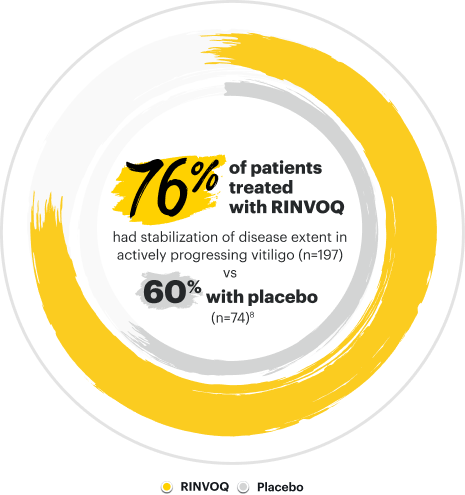
RANKED SECONDARY ENDPOINT
VITI-UP 1
76% RINVOQ 15 mg (n=107/141)
60% placebo (n=38/63)
VITI-UP 2
76% RINVOQ 15 mg (n=90/119)
61% placebo (n=36/59)
GOAL 2: REPIGMENT
RINVOQ Delivered Visible Results for the Whole Body at Week 481
Proportion of Patients Achieving the Co-primary Endpoints of F-VASI 75 or T-VASI 50 at Week 48

*p≤0.001; RINVOQ vs placebo. NRI; ITT.
Patients Saw Continued Improvement in Repigmentation Over Time1,8,11,12,14

F-VASI 75 at Week 24 (Ranked Secondary Endpoint)
VITI-UP 1 15%* RINVOQ 15 mg (n=206) 2% Placebo (n=102)
VITI-UP 2 11%* RINVOQ 15 mg (n=205) 1% Placebo (n=101)
F-VASI 75 at Week 48 (Co-primary Endpoint)
VITI-UP 1 25%* RINVOQ 15 mg (n=206) 6% Placebo (n=102)
VITI-UP 2 23%* RINVOQ 15 mg (n=205) 7% Placebo (n=101)
F-VASI 75 at Week 76 (Observed Cases)
VITI-UP 1 55% RINVOQ 15 mg (n=127)
VITI-UP 2 47% RINVOQ 15 mg (n=137)
*p≤0.001; RINVOQ vs placebo. NRI; ITT.
Data Limitations
Integrated analysis of mean percent change in F-VASI at Week 76 was a non-ranked endpoint and not controlled for multiplicity. No statistical or clinical conclusions can be drawn.
OLE Limitations
In an OLE, there is potential for enrichment of the long-term data in the remaining patient populations since patients who are unable to tolerate or do not respond to the drug often drop out.
AO Disclosure
In an AO analysis, missing visit data were excluded from calculations for that visit, which may increase the percent of responders. All observed data were used regardless of premature discontinuation of study drug or initiation of concomitant medications. The same patient may not have a response at each time point.
Patients Saw Continued Improvement in Repigmentation Over Time1,8,11,14

T-VASI 50 at Week 48 (Co-primary Endpoint)
VITI-UP 1 19%* RINVOQ 15 mg (n=206) 6% Placebo (n=102)
VITI-UP 2 21%* RINVOQ 15 mg (n=205) 6% Placebo (n=101)
T-VASI 50 at Week 76 (Observed Cases)
VITI-UP 1 43% RINVOQ 15 mg (n=127)
VITI-UP 2 40% RINVOQ 15 mg (n=137)
*p≤0.001; RINVOQ vs placebo. NRI; ITT.
Data Limitations
Integrated analysis of mean percent change in T-VASI at Week 76 was a non-ranked endpoint and not controlled for multiplicity. No statistical or clinical conclusions can be drawn.
OLE Limitations
In an OLE, there is potential for enrichment of the long-term data in the remaining patient populations since patients who are unable to tolerate or do not respond to the drug often drop out.
AO Disclosure
In an AO analysis, missing visit data were excluded from calculations from that visit, which may increase the percent of responders. All observed data was used regardless of premature discontinuation of study drug, or initiation of concomitant medications. The same patient may not have a response at each timepoint.
Facial Repigmentation at Week 488,12
Integrated Results From VITI-UP 1 and VITI-UP 2; ITT

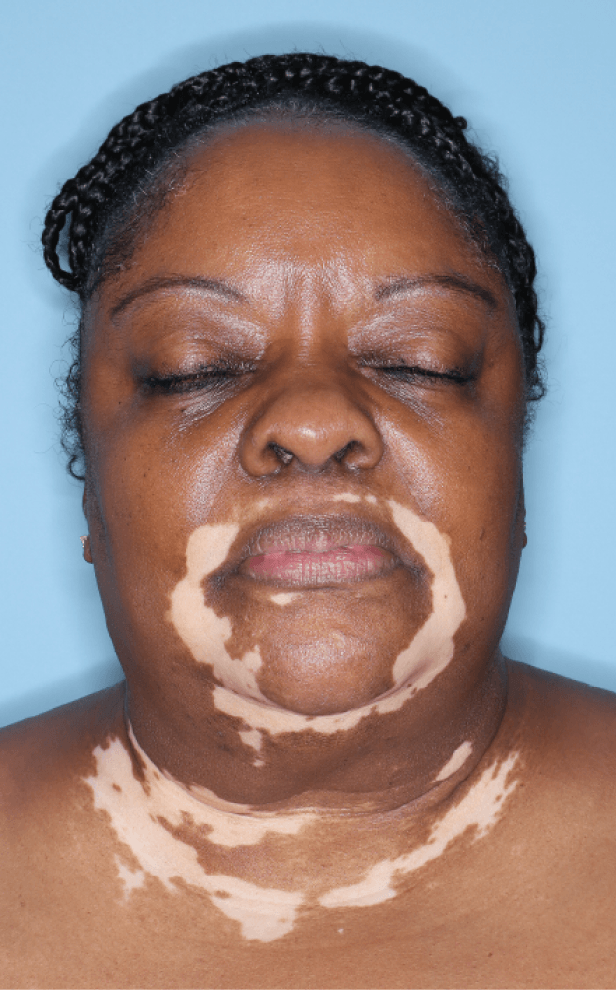
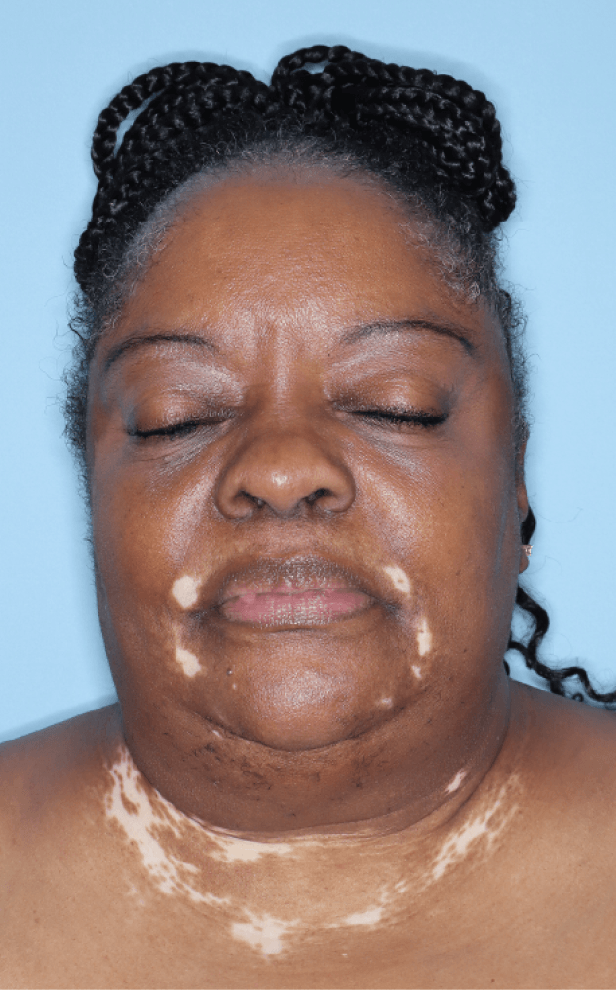
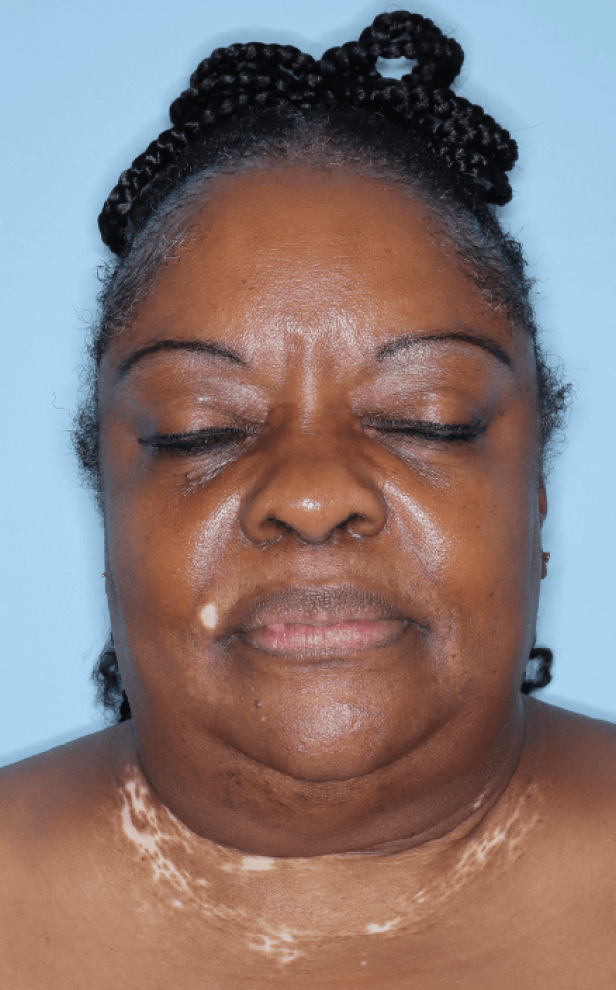
Clinical Trial Photos13
Adult: Face - F-VASI
Actual VITI-UP patient treated with RINVOQ 15 mg in a clinical trial. Individual results may vary.
Baseline F-VASI 0.7

IMPROVEMENT

IMPROVEMENT
SAFETY CONSIDERATIONS
Serious Infections: RINVOQ-treated patients are at increased risk of serious bacterial (including tuberculosis [TB]), fungal, viral, and opportunistic infections leading to hospitalization or death. Most patients who developed these infections were taking concomitant immunosuppressants, such as methotrexate or corticosteroids.
Mortality: A higher rate of all-cause mortality, including sudden cardiovascular (CV) death, was observed with a Janus kinase inhibitor (JAKi) in a study comparing another JAKi with tumor necrosis factor (TNF) blockers in rheumatoid arthritis (RA) patients ≥50 years with ≥1 CV risk factor.
Malignancies: Malignancies have occurred in RINVOQ-treated patients. A higher rate of lymphomas and lung cancer (in current or past smokers) was observed with another JAKi when compared with TNF blockers in RA patients.
Major Adverse Cardiovascular Events: A higher rate of CV death, myocardial infarction, and stroke was observed with a JAKi in a study comparing another JAKi with TNF blockers in RA patients ≥50 years with ≥1 CV risk factor. History of smoking increases risk.
Thromboses: Deep venous thrombosis, pulmonary embolism, arterial thrombosis, and cerebral venous thrombosis have occurred in patients treated for inflammatory conditions with JAK inhibitors, including RINVOQ. A higher rate of thrombosis was observed with another JAKi when compared with TNF blockers in RA patients.
Hypersensitivity: RINVOQ is contraindicated in patients with hypersensitivity to RINVOQ or its excipients.
Other Serious Adverse Reactions: Hypersensitivity reactions; gastrointestinal perforations; hypoglycemia in patients with diabetes; laboratory abnormalities; and embryo-fetal toxicity.
GOAL 3: MAINTAIN
Long-term Repigmentation Results for the Whole Body1,9,10
Maintenance of Response Data at Week 76
Post-Hoc Integrated Analysis of VITI-UP 1 and VITI-UP 2, As Observed (AO)
F-VASI 75 at Week 48
In VITI-UP 1 and VITI-UP 2
24% (n=100/411) of patients achieved F-VASI 75 at Week 48
Of those who achieved F-VASI 75 at Week 48 and had data available at Week 76
Kept Their F-VASI 75 Response
n=77/78
T-VASI 50 at Week 48
In VITI-UP 1 and VITI-UP 2
20% (n=84/411) of patients achieved T-VASI 50 at Week 48

Of those who achieved T-VASI 50 at Week 48 and had data available at Week 76
Kept Their T-VASI 50 Response
n=70/72
Data Limitations
Maintenance of F-VASI 75 and T-VASI 50 response at Week 76 were post hoc analyses, not controlled for multiplicity, and did not include a placebo comparison; therefore, results cannot be considered statistically significant.
OLE Limitations
In an OLE, there is potential for enrichment of the long-term data in the remaining patient populations since patients who are unable to tolerate or do not respond to the drug often drop out.
AO Disclosure
In an AO analysis, missing visit data were excluded from calculations from that visit, which may increase the percent of responders. All observed data was used regardless of premature discontinuation of study drug, or initiation of concomitant medications. The same patient may not have a response at each timepoint.

The first RINVOQ trial in dermatology with 48 weeks of placebo-controlled data1*
*This was not powered or designed to detect safety outcomes.

